Someone typed the exact question your product answers into Google last week. They got a complete answer right there on the results page, closed the tab, and moved on with their day. Your website never loaded. Your analytics platform never logged a session, the standard record of a single visit. As far as your dashboard is concerned, that person never existed.
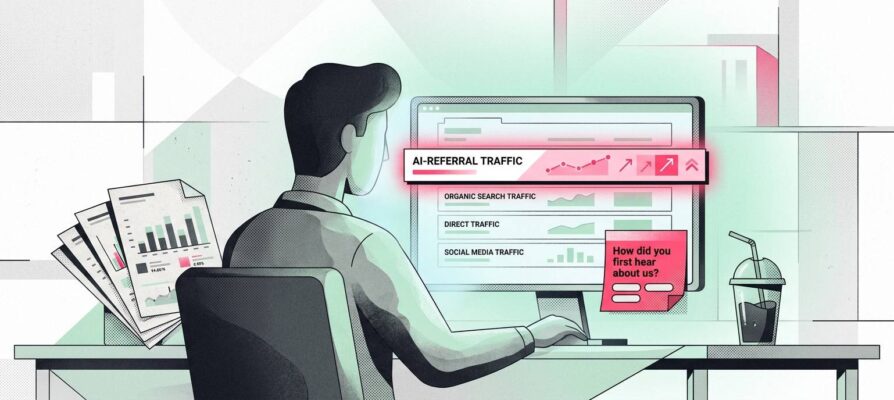
Marketing performance can no longer be measured by clicks and sessions alone. Proving it now takes three things running at once: tracking AI-referral traffic as its own channel instead of folding it into “organic search,” measuring how accurately your brand shows up inside AI-generated answers rather than just counting mentions, and capturing self-reported attribution at the point someone actually converts, so you catch the buyers who researched and decided without leaving a single trackable click behind.
Two separate shifts are forcing this, and most marketing teams have only clocked one of them so far.
The Click You’re Losing
Search still finds your content. It has simply stopped sending people to read it as often as it used to, because Google increasingly answers the question itself before a visitor ever reaches your page.
Ranking first buys you less than it did a year ago. Ahrefs re-ran its clickthrough study using December 2025 data and found that when an AI Overview, Google’s AI-written answer box that appears above the normal search listings, shows up on a results page, the top-ranking page now gets a 58% lower average clickthrough rate (the share of people who see a result and click it). That’s nearly double the 34.5% drop the same team measured just eight months earlier.
Why Ranking First Doesn’t Mean What It Used To
Search visibility and search traffic used to be the same thing. A page that ranked well got clicked; a page that got clicked drove revenue. AI Overviews break that chain in the middle. Your content can still be the source Google’s summary is built from, and still never get credited with a visit, because the summary answers the question before anyone reaches the page it came from.
Real users are clicking through less than half as often when an AI summary appears. Pew Research Center’s data on search behavior found that only 8% of people who encountered an AI Overview clicked on a traditional link afterward, roughly half the rate of people who searched the same kind of query without one.
The Real Clickthrough Numbers Behind AI Overviews
Two independent studies, run six months apart by two different organizations, land on the same uncomfortable number: somewhere between half and two-thirds of the clicks a page used to earn from a strong ranking are gone, not because the ranking dropped, but because the click was never necessary in the first place.
These numbers don’t mean fewer people care about what you do; they mean the meter marketers have used for two decades to prove search is working, the click, is measuring less of what’s actually happening every month.
The Buyer You Never See
The click problem gets worse, and more specific to B2B, one step further down the funnel. Buyers aren’t just clicking less on the way to your site. Increasingly, they’re doing their research somewhere your analytics can’t reach at all.
Generative AI has become the default first stop for B2B research, not a side experiment. Recent buyer-journey research from Apollo found that 89% of B2B buyers now use a generative AI tool as a primary part of how they research a purchase, and separate data from Responsive, reported through eMarketer, found that 80% of B2B tech buyers use generative AI as much as traditional search when researching vendors, with 47% using it specifically for market discovery.
Generative AI Has Become a Default Research Tool for B2B Buyers
Ask a room full of B2B buyers how they start researching a new vendor now, and a growing majority will mention a chat window before they mention Google. That research happens inside a conversation with no referrer (the data telling your analytics where a visitor came from) and no session for your analytics platform to log. It’s the same disappearing-click problem from the section above, except here the click was never going to happen even in principle.
Shortlists are shrinking, so getting missed at the AI research stage costs more than it used to. The same Apollo research found that buyers now evaluate an average of 2.5 vendors before deciding, down from 3.2. Forrester built an entire keynote around this shift for its 2026 B2B Summit, framing it as a “visibility vacuum,” their term for how AI-driven search and AI agents are reshaping which vendors buyers even find in the first place.
Shorter Shortlists Mean Less Room for Error
Fewer vendors are making it onto the list a buyer actually considers, and the cut is happening earlier than ever, often before a human at the buying company has spoken to anyone on your team. If an AI tool’s synthesized answer leaves your brand out, or gets a detail about you wrong, you may never know a deal was lost, because you never knew the buyer existed.
Between the vanishing click and the invisible research phase, the tools most teams rely on to prove marketing works are covering a shrinking share of what buyers actually do.
How should we actually be measuring marketing performance now that clicks don’t tell the whole story?
We asked Dennis Kamprad, our Senior Digital Marketing Consultant, to weigh in directly, since this is the exact question clients have been bringing to him over the past few months.
Is content marketing still important if it doesn’t generate clicks anymore? Yes, but for a different reason. While the decision-making process used to happen on your website and that of your competitors, this process has now shifted one step earlier: to the chat models and AI overviews. And your content plays a key role here, even without clicks.
How should we measure performance without clicks? Mentions, citations, and impressions are key criteria to measure. Those are your “share of voice.” It’s now all about those touch-points that lead to a decision. For any business, the most important part is that final conversions don’t drop. No matter where that purchase decision takes place (unless you are an online publication, of course).
How should we prepare for the new zero-click reality? What used to be “topical authority” has become much more nuanced as “entity authority.” You need to ask yourself the question of which entities you stand for. And then strategically prepare relevant content that covers these entities from those different angles that your customers would use to research them. Even if they might lead to articles that generate zero clicks and traffic, they might still play an important role in the decision-making process that happens before any click.
Your Next Steps for Measuring Marketing in an AI-Driven World
The teams that get hurt worst by this shift won’t be the ones with the smallest AI-referral numbers. They’ll be the ones still reporting on clicks and sessions as if nothing changed, making budget calls off a number that’s shrinking for reasons that have nothing to do with performance. Fixing that isn’t a one-time project. It’s a change to what counts as a complete measurement stack.